Or to be more specific, how to convert a passive stereo volume pedal to an expression pedal that works with my particular pedals.
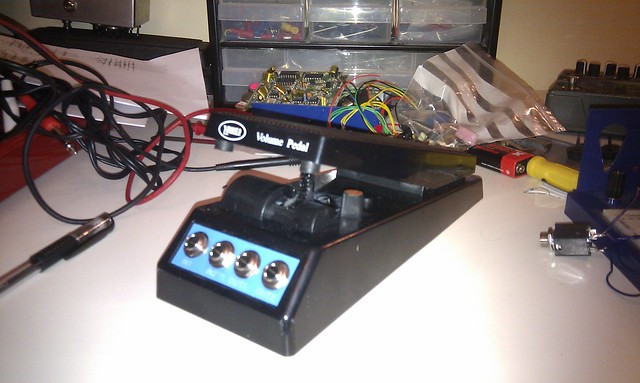
First let's take a look at the Harrier stereo volume pedal that I bought cheaply on eBay:
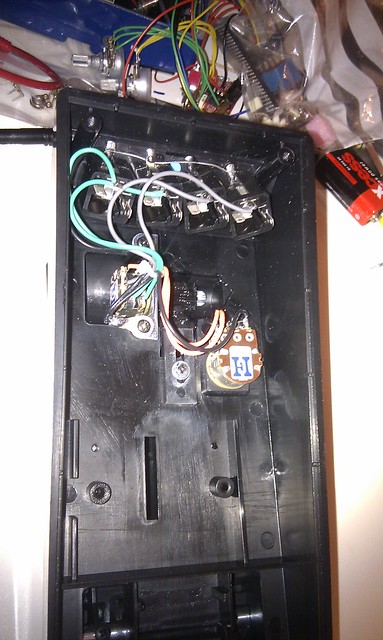
Considering it's plastic, it's very nicely made. It must be a template for other pedals like wah's etc because there's a battery holder inside and a place to mount a pcb. As I suspected there's a dual gang pot in there (to operate the stereo volume) as well as a dual gang pot connected to a knob under the treadle so you can set a minimum value of volume. I'm going to be ignoring this for this exercise as you can essentially dial it out of the circuit.
Now I wasn't really in the market for a stereo volume pedal. I don't run a stereo rig (yet) and even if I did, I get the feeling I'd need something more durable and higher spec than this. I would however like to know it's there if I need it, but also to be able to use it as an expression pedal.
Express yourself
I plugged a stereo cable into Out1 and ran it it to my Eventide Timefactor pedal. It worked straight away, but once you get the pedal half way up the expression is at 100%. That's no good.
Looking at the dual gang pots they're both 50k linear (odd that a volume pedal has linear pots and not logarithmic..)
Reading up on the
Eventide Timefactor FAQ's, I find that the Timefactor only likes expression pedals up to 25k, which explains the maxing out at halfway point.
Why didn't you use the insert cable trick?
Some pedals will
happily accept a volume pedal as an expression pedal using
this trick. I
tried it, but it still gave me 50k at the extreme end so it won't
work here.
So what do I do? Put in a dual gang 25k pot? That's going to affect the volume capability of the pedal, and finding an identical shaped pot in the UK will be a headache. After much deliberation, I came up with this idea:
Run both outputs in parallel. The simple rule about resistors in parallel tells us that:
1/R = 1/R1+1/R2+....
So in this case if we run two 50k pots in parallel, the maximum resistance will be:
1/((1/50k)+(1/50k)) = 25k.
Perfect! The taper of the pots will still be linear too which is nice.
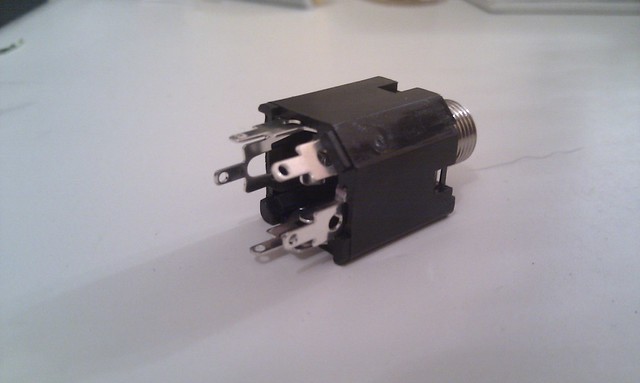
Now my next issue, permanently wiring the output pots in parallel will ruin any volume capability of the pedal. I still want that option, either in mono or stereo. Enter this little fella:
Similar to the jacks currently in the pedal, but these are switched on the tip and ring lugs. Basically when you insert a jack socket, a connection breaks between the tip and a lug, and the ring and a lug. My solution is to reroute output 1 to output 2, but only if there's no jack in output 1. The benefits of this are:
- Can still use the pedal as a mono volume pedal
- Can still use the pedal as a stereo volume pedal
- Can use the pedal as a 25k expression pedal (when using Out2 alone)
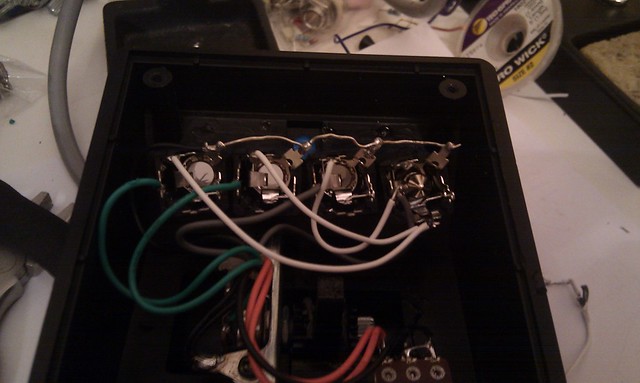
The '1' signal goes to Out1 as normal, but then the switched lug on the tip of Out1 goes to the tip lug on Out2. So when there's no jack in Out1, both signals pass into Out2. I say signals, this will just be a resistance. When there is a jack in Out1, Out2 has a stray piece of wire attached to it, not bothering anybody.
At this point the pedal worked with the Timefactor, but not so well with my Zoom G2, why? Well despite using a stereo cable, the pedals are still only seeing a mono signal (resistance between tip and sleeve). Timefactor doesn't care, but Zoom does.
So I tried the insert trick mentioned above again, and it worked! At 25K no less, but I ain't swapping no cables for different pedals, besides the Timefactor doesn't care either way (good old Eventide). So all I did was to use the same switching trick, this time sending In1 and In2 to the ring lug on Out2 (when nothing is connected to the inputs).
Looking at the white wires above, they only do their job if nothing is connected to In1, In2, and Out1 ie. expression mode. Otherwise you can use it as a stereo or volume pedal as normal. So the expression mod is essentially hooking up the dual gang pot in its entirety (all three lugs of the pot) to the Out2 to give a 25k TRS based expression pedal
Lessons learned
- I didn't need to replace all the jacks, but seeing as I eventually needed 3 switched ones, it made sense.
- The pedal actually reads around 26k, which means the last 1cm or so of the treadle does nothing. Not sure how to remedy this, besides it feels ok to play. Can't really adjust the pinion/pot because it does go down to 0 at the heel end.